January 15, 2024 · 8 min read
As the first light of dawn breaks over the ancient city of Anuradhapura, something magical happens. The massive white dagobas-Buddhist stupas that have stood for over two thousand years, begin to glow with an ethereal luminescence, their lime-washed surfaces catching the golden rays of the rising sun.
This is Sri Lanka's first capital, a city that flourished for over 1,400 years and served as the cradle of Theravada Buddhism. Today, it remains one of the most sacred pilgrimage sites in the Buddhist world, yet it receives a fraction of the visitors that flock to more famous destinations.
To move through Anuradhapura slowly is to feel the scale of a kingdom that understood ceremony, engineering, water, faith, and public life as one connected system. Monasteries were not isolated sanctuaries; they were living cities with hospitals, refectories, libraries, gardens, moonstones, bathing ponds, and meditation paths.
The Sacred Bo Tree
At the heart of Anuradhapura stands the Sri Maha Bodhi, the oldest historically documented tree in the world. Planted in 288 BCE, this sacred fig tree was grown from a cutting of the original Bodhi tree in India, under which the Buddha attained enlightenment.
The shrine is busiest in the cool hours of morning and evening, when families arrive dressed in white, carrying lotus flowers, jasmine garlands, incense, and small bowls of water. The devotion is quiet but constant. Bells ring softly, monks chant from shaded halls, and pilgrims circle the tree with the same measured patience that has shaped this city for centuries.
"Standing before the Sri Maha Bodhi, you're not just looking at a tree. You're witnessing a living connection to the Buddha himself, maintained by an unbroken chain of devotion spanning 23 centuries."
- Venerable Ananda Thero, Chief Monk of Anuradhapura
Pilgrims from around the world come to offer flowers, light oil lamps, and meditate beneath its spreading branches. The atmosphere is one of profound peace and reverence, a stark contrast to the bustling tourist sites elsewhere on the island.
The Colossal Dagobas
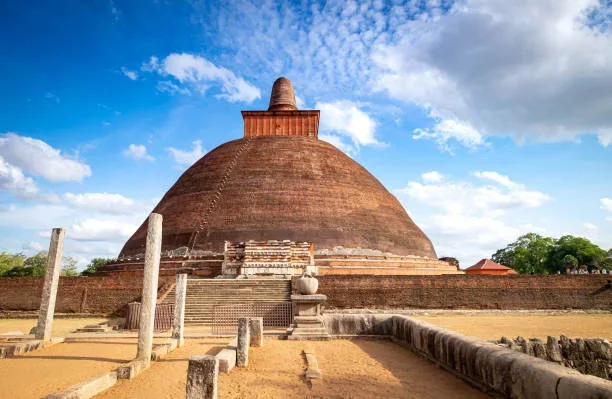
Anuradhapura is home to some of the largest brick structures in the ancient world. The Jetavanaramaya dagoba, built in the 3rd century CE, once stood 122 meters tall, making it the third tallest structure in the ancient world after the pyramids of Giza.
Walking around these massive monuments, you can't help but marvel at the engineering prowess of ancient Sri Lankan civilization. Each brick was handmade, each stone carefully placed by devotees who believed they were accumulating merit for future lives.
Ruwanwelisaya, Abhayagiri, and Jetavanaramaya each carry a different emotional weight. Ruwanwelisaya feels ceremonial and luminous, Abhayagiri feels expansive and scholarly, while Jetavanaramaya feels almost geological in its mass. Together they reveal how Buddhism, royal power, and artistic ambition shaped the ancient capital.
Beyond the Famous Sites
The most rewarding moments often happen between the major monuments. A carved guardstone beside a half-hidden stairway, a ruined refectory with a stone rice trough, or a lotus pond framed by trees can say as much about daily monastic life as the grand stupas do about royal devotion.
Hire a guide who knows the lesser-visited monasteries and allow time for silence. The city is not only a checklist of sacred monuments. It is a landscape of thresholds, where jungle, stone, water, and worship continually fold into one another.
Practical Tips for Visitors
The sacred city is best explored over two days, allowing time to absorb the spiritual atmosphere rather than rushing between sites. Dress modestly, shoulders and knees should be covered, and remove shoes before entering temple grounds.
The best time to visit is during the full moon poya days, when thousands of white-clad pilgrims gather for ceremonies that have remained unchanged for millennia. It's a profound experience that offers a window into living Buddhism.
Start early, pause through the midday heat, and return near sunset when the brickwork turns copper and the white stupas catch the last light. Bring socks for hot stone courtyards, keep small notes for shrine donations, and treat active worship spaces as living temples rather than archaeological backdrops.